Building GameSieve for GOG: A Chat With the Developer

For some PC players, GOG is more than just another storefront. It’s the place where old favorite PC games are preserved instead of forgotten, where DRM-free still actually means something, and where games don’t disappear just because licensing got messy or trends moved on. It’s a platform built around ownership and longevity, and that makes it quietly vital in an industry that’s increasingly comfortable with subscriptions, revocations, and always-online everything. But as GOG’s catalogue has grown: stretching across decades, genres, editions, and re-releases, actually browsing it and keeping track of pricing changes has become a bit harder than it should be.
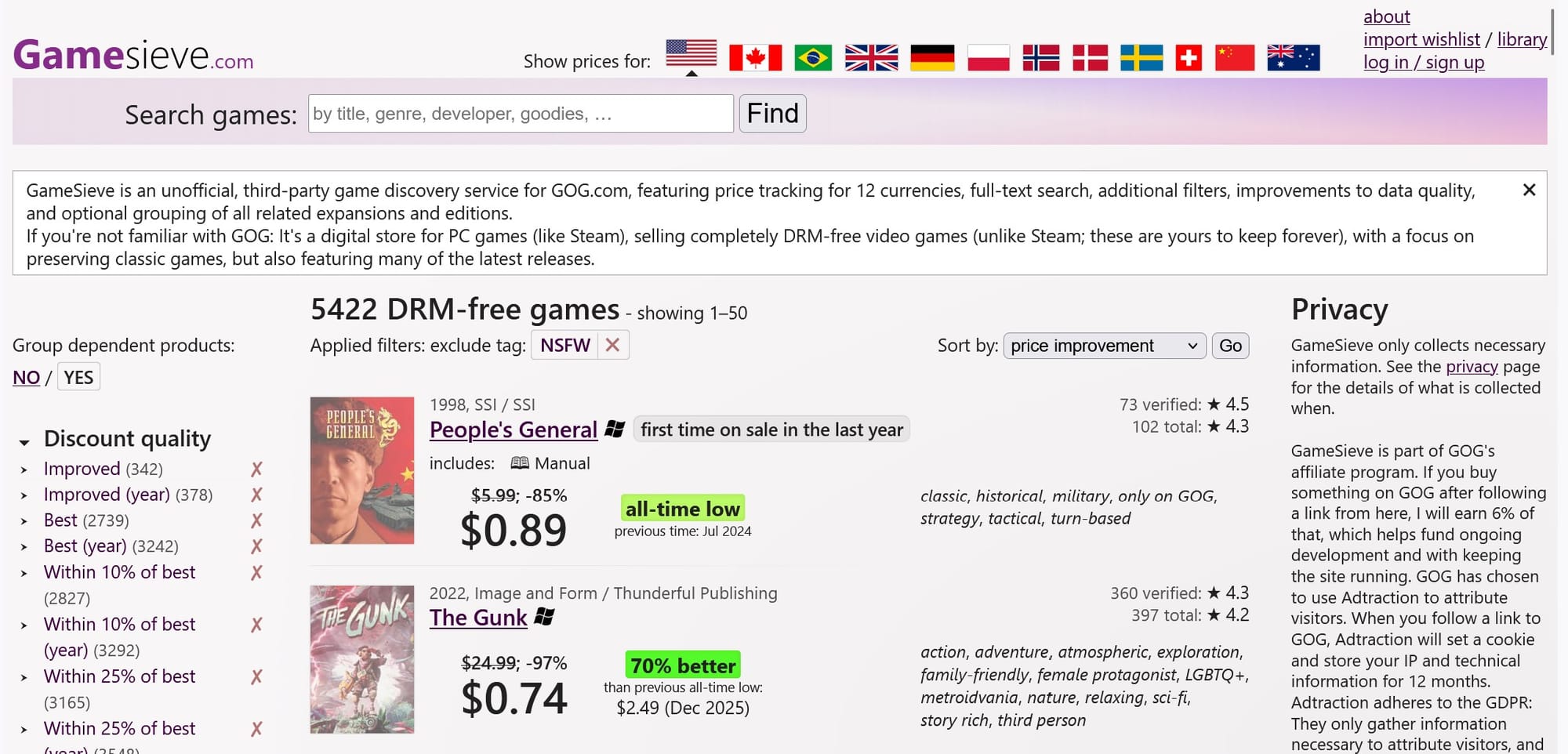
That’s where GameSieve comes in. GameSieve acts as a powerful lens over GOG’s site: a way to search, sort, filter, and compare the entire catalogue with far more flexibility than the official storefront allows. It brings together full-text search, smarter grouping of editions and expansions, deep filtering options, and detailed price history tracking, all designed to help you surface games you might otherwise miss...or spot whether that deal is actually a good one.
At its core, GameSieve is about discovery and clarity. Whether you’re hunting for forgotten classics, tracking price drops across regions, or just trying to make sense of GOG’s increasingly sprawling library, it gives you the tools to browse the platform on your own terms. To understand how it came together, and where it’s headed next, I spoke with the developer behind GameSieve about its origins, its technical challenges, and why tools like this matter for platforms like GOG.

So tell me how you came up with GameSieve? It’s almost like a niche-within-a-niche (GOG gaming isn’t on everyone’s radars, and game price sites are also not on everyone’s radars), tell me how it all began!
GameSieve: It was lots of things coming together, really. On the personal side, I’d come off a long-term project where I’d had to pile on the added responsibilities of acting as the product owner on top of my tech lead role, which had left me – in hindsight – pretty burned out. I’d somewhat fallen out of love with hands on programming, and wanted to recapture that with a personal project of sufficient scope to be interesting, without immediately going all big data. GOG’s catalog was a perfect fit for that.
On the functional side, I’ve been a fan of GOG for a long time, but have also seen all the small frustrations where they’re just not quite managing to be as good as they could be. I kept discovering years old games I ended up loving which I’d never seen before, while the homepage always seemed to be promoting the same tired old games I’d dismissed countless times before.
There’s been a steady effort over the years on tooling around GOG; Yepoleb’s gogdb is deservedly very well known, and before that was mrkgnao’s magog, and WinterSnowfall’s API exploration, and so it felt natural to stand on all their shoulders and think about contributing in this space. Existing price trackers – are those niche? I never considered that – very much don’t seem to be built for exploration, so I felt there was a gap there I could fill – a tool I could create which would primarily offer the things I myself wanted, but in a general way useful to everyone else as well. It helped that I had enough experience in relevant technologies to make headway, but not enough to be bored doing so.
How would you describe GameSieve in one sentence to someone who uses the GOG storefront, but might not be aware of it?
GameSieve: GameSieve is a GOG-only game discovery service, search engine and price tracker – basically a better way to explore GOG's catalog.
Tell me what GOG means to you? Being my favorite storefront for a multitude of reasons, I’ve seen it mean different things to different people, now...your turn to explain why its important!
GameSieve: Ownership is what it’s really all about for me, and thus DRM-free installers. That extends to all areas of entertainment for me – I have a huge CD library, overflowing bookcases and a decent DVD collection. The concept that some commercial entity could take away something I bought, or make me pay extra to retain access to it – that it’s now normalized that you don’t buy things, but rent them, that you get a temporary license! – it gets my hackles up in the worst way.
There’s been a fair number of community-made projects this year, which has been amazing to see. Have you been in touch with any of those, just as another contributor to the scene?
GameSieve: Not in any significant manner. I love how there are all these new efforts in the community around GOG, I’ve given some advice in a few instances based on my knowledge of the API, and I follow along conceptually just to have a feel for what all is being done, but I don’t currently have the capacity or the desire to do more than that.
You’re a solo developer on this, and it’s a lot of work. Have you ever asked if anyone else want’s to join in?
GameSieve: I haven’t, and very deliberately so. As I mentioned, I started GameSieve after the experience of being responsible for a team in multiple ways, and so it’s felt really liberating to keep GameSieve as a purely personal project. It allows me focus, and to cut corners in ways which you simply can’t when you have to collaborate. I have only written unit tests for the most crucial and complex bits of my code, and there are entire areas of my current codebase which I’d dismiss out of hand during code review, but which stay out of my way and allow me to get on with the more important things. I feel I’d have to clean up those areas of my code before bringing in anyone else, which together with the effort of having to align visions for what GameSieve is and could become, is a whole bunch of work I’d rather just avoid altogether. (That’s purely my attitude around GameSieve, I’m honestly not quite as anti-social as all that!)
When did development start, and how long did it take to reach your first public alpha?
GameSieve: There was a period of several months where I was exploring various ideas for what I’d want to work on, and what technologies I’d be using. For example, early on I thought this project might be a good way to pick up experience with some modern front-end framework, so I started fully exploring what they mean, before realizing they weren’t “sparking joy”, and really, I’ve never cared about CV-driven development, so why would I start now? In the end, my first commit for what would become GameSieve was made in November 2024, development really kicked off in December, and then I shared its existence in April 2025, after a mere week of letting a few community members get an early sneak-peek.
You offer full-text search, grouping of editions, and advanced filters. Which feature do users most appreciate so far? How’d you end up choosing what you have?
GameSieve: I really see very distinct usage patterns – some people filter heavily, digging for new gems in their favorite genres, some know what they want and just search for a price check on a specific game, and others browse very widely. Possibly it’s the same people engaging in all behaviors? I purposefully don’t track in any way where I can tell. Feedback has been quite varied as well. I have a few users who turn off grouping to get cleaner and clearer filters, while others love grouping and call it a game changer. It really depends on what you want to get out of the site, and I love that I can enable such a wide range of usage patterns, all around the core concept of more extensive ways to explore GOG’s catalog.
Actually, probably the one thing which more people have commented favorably upon than any other, is how GameSieve is completely usable without JavaScript (although it’s certainly better with), and that I have clean and bookmarkable URLs. GOG users are weird like that, and I dearly love them for it, for these are things I myself care about as well.
Grouping all related store products together was a core concept of my original vision for the site, something which guided several architectural decisions and technology choices. It was a personal desire – something I was sorely missing on GOG – where for games with multiple editions and DLCs I just wanted a clear overview of what all was available which didn’t require opening a dozen tabs.
My list of filters grew out of simply looking intelligently at the available data and figuring out what would be possible and useful, combined with keeping track of what type of requests people were making of GOG itself, and then figuring out which would fit.
Which data sources do you rely on (GOG API, community lists, gogdb, other scrapers)? How do you reconcile conflicting data (e.g., release dates)?
GameSieve: GOG’s APIs are the core of it all. They’re imperfect and inconsistent in myriad ways, but I knew that from the start, so I’ve built tooling to make it easy for myself to correct various type of data. Gogdb made historical price tracking information available (downloadable; Yepoleb really is the best!), which gave me price history from April 2021 until the start of my own tracking in December 2024, and that’s it for my direct data dependencies. I have a bunch of heuristics in my tooling which cause suspect data to be flagged, and then I resort to manual labor to correct it. For initially filling in missing release dates – particularly difficult when the game was in early-access when first showing up on GOG – there are a bunch of threads on the GOG forum where people tirelessly kept track of unannounced releases, gogdb’s change history was invaluable, and I also resorted to looking at steamdb, various wikis and just running general web searches.
How do you handle delisted or removed games in the database? Do you expose historical data or hide it from normal searches?
GameSieve: For the moment I only offer a view of what’s in the store, so hide products which are no longer available. Gogdb already offers access to old product information, and I try to build new functionality rather than duplicate what’s there. Maybe some day when I run out of other features to build, I’ll take a second look at making historical information available.
How accurate are the extrapolated pre-history prices for non-US markets? Do you warn users about possible inaccuracies?
GameSieve: I have no way of really knowing, but based on the behaviour I’ve observed since I started tracking, discount percentages are near-identical between all currencies, at most fluctuating by 1-2% due to rounding to psychological prices. When I don’t have hard data on the lowest cost in other currencies, I purposefully don’t show an extrapolated price, but just the historical discount percentage, with an explicit note that that’s based on US price history. Local base prices do get adjusted quite a bit for individual products in some countries, so over the entire catalog there’ll probably be dozens of products where that implication will turn out to be wrong, but that becomes less of an issue the further we move ahead, as more and more historical lows will have occurred during the time period for which I’ve been tracking all my countries.
How do you rank search results (relevance signals, popularity, ratings, price delta)? Any machine-learning / heuristics in play?
GameSieve: I find that relevance ranking of searches within large data sets is really more an art than a science, where very subtle tweaks with boosts and weights can make a lot of difference, and you need a good understanding of your data and loads of representative test cases to know how to balance those tweaks. The number of products in GOG’s catalog isn’t really large enough for me to go all fancy, though. In most cases there’ll either be a handful of good title matches, or a genre match. Little more is needed to get the right products to float to the top, while there’s not enough signal to determine a more “correct” ranking for the long tail of matches in product descriptions. I honestly spent more time adjusting the sorting of my default browsing view to get new and interesting deals to float up than I did to get the relevance ranking for searching to behave well.
My main struggle here is actually with the expectations of my visitors. When searching for the name of a game, many people would prefer to not get a long-tail of other games where each individual word happens to occur in some other field, and it doesn’t matter that their desired game(s) are ranked at the very top of the page. Yet searching in other fields is essential for more exploratory niche genre searches, and I’ve found it impossible to cleanly distinguish between the two types of searches.
What are the privacy implications of accounts/wishlist import? Do you store user tokens or data, and how do you secure that information?
GameSieve: So here in Europe we have the big privacy law, the GDPR. Many people love to hate the law due to the rise of consent banners, but it’s really the marketing departments of companies going for malicious compliance which should be hated on, as the whole intent of the law is to get companies to think about if they actually need personal data, and do without when they don’t.


Anyway, when the GDPR was introduced, I remember being really impressed by its core principles, like “data minimization by design”. Those have become pretty ingrained for me. When you choose to import your wishlist or library into GameSieve, the only link I have to GOG – the only piece of outside information I store besides the actual contents of your wishlist or library – is your GOG userid, which I need so that if you choose to import a second time, I know which account to update.
For the longest time during development I was also storing GOG usernames, as the library import route I was exploring used an API call which needed that username – but when I determined that API simply couldn’t give me good enough data and I moved to a solution where library import happens through copy/pasting the contents of a JSON file, I was extremely pleased to be able to drop the necessity of storing GOG usernames.
So, no, I don’t store any GOG authentication credentials or tokens for my users. It’d certainly make various processes simpler, but I’d never want the responsibility of securing that data. If I don’t have it, I don’t need to spend effort securing it, and I also can’t lose it.
You post a lot on the GOG forum and share with reddit and the fediverse also. How much of your roadmap is community-driven? Is it at all? Do you accept feature requests or pull requests from the community?
GameSieve: My roadmap is community-inspired, but not community-driven. Expressed wishes help set my priorities, but I work on those things which I want to work on. It makes me happy when people use my site, when they’re excited about my site, when I can offer them something useful – and so I’ll very happily add small features as they’re requested when they fit with my vision for the site – but they do need to fit.
In practice, community feedback and requests are extremely helpful with evolving my vision for the site. By now there have been quite a few requests which I’ve answered as “not for the foreseeable future”, but which together have lodged in the back of my mind, and I can start seeing groups of related functionality between them, and ways in which that could eventually slot into the site. Sometimes it’s just worth it to let such things bake for a while.
And I probably wouldn’t have tackled the recently added wishlist and library import functionalities if they hadn’t been requested quite as often as they were. They were a tentative part of my initial long-term vision, but building that – without letting performance suffer – was a project as large as setting up the site initially, so it really helped to know there was demand.
What usage metrics do you track (active users, search queries/day, wishlist imports), if any at all? Any surprising usage patterns if you do?
GameSieve: I track effectively nothing. I do keep tabs on my traffic to spot patterns and see where people are coming from, and have logs to dig into when bugs are encountered – but everything containing visitor data gets auto-deleted after a few weeks, so in essence it’s all ephemeral.
The most surprising – and annoying – thing is just how vexatious AI scrapers have become. The big ones at least honor robots.txt, but there are now dedicated scraper services specifically designed to bypass all common protections, selling their services to starting AI-companies, and then requesting the same data multiple times – from big data centers, residential proxies and Tor, all masquerading as regular browsers – probably just to make certain that the data they scrape isn’t poisoned. Meanwhile they hallucinate plausible-looking but invalid URLs, and don’t pay any attention to if the data they scrape is actually useful, or if maybe my signals indicating that bots should ignore certain links have actual merit. I’ve had spikes where more than half of my available server capacity was going to a single scraper, so I’ve had to get pretty aggressive with blocking abusive bots, both based on obvious signals – I’ve sadly resorted to blocking whole swaths of older browsers altogether – and on more subtle cues.
Actual usage of old browsers is a surprising thing in itself, in that a small but significant percentage of GOG users maintain dedicated Windows 7 gaming machines, and visit GameSieve on them. I hail from the era where websites still had to work with the eternally outdated and buggy Internet Explorer 6, so the modern day landscape where I get to use nearly all the latest web technologies and only have to check if they are supported in 2.5 year old browsers like Firefox 115 (the latest one supported on Windows 7) still feels magical to me – but all the same I hadn’t expected it, thinking that all browsers auto-update, and so I could finally live on the bleeding edge. Alas, that was not to be.
I also like how Firefox is by far the most used browser for my visitors. Did I mention how much I appreciate GOG users, and the things they so very obviously care about?
You’ve mentioned to me your next step for GameSieve, can you explain what that is and was? And maybe touch on what might be next? In a perfect world, what would you love to see on GameSieve, feature-wise?
GameSieve: I already mentioned it earlier, but I just went live with the ability to import your GOG wishlist and library, and filter by them. I’ve enhanced GOG’s features around these by also making it possible for my users to set priorities for the items on their wishlists, to indicate that there are certain games they never want to see (a hidelist), and to indicate when they already own games elsewhere.
From the beginning, this set of functionality was pretty much the entire long term vision for what I wanted to achieve with GameSieve, so I’m now starting in on a period where I’m building out on all the new capabilities with small improvements.
Some of my users have expressed hesitation about making their wishlists public for even the few minutes which the import takes, so I’m going to offer an alternative copy/paste import option there, similar to the way I handle library import. With library import I try to detect “effectively” owned games to work around some GOG limitations where they don’t properly indicate that in the store (frequently encountered with Amazon freebies), and due to user feedback I now have a really good approach on how to improve this detection.
Building out on the lists – and now we’re getting to the purely speculative ideas, where I have no idea yet if I’ll ever actually manage to implement them – I’ve been wanting to recreate an old long-since-abandoned GOG feature called “mixes”, which are basically user-curated lists of games, with added commentary on each. They’d need some different architectural choices again compared to my current lists, and I haven’t yet investigated if that’s doable, but it certainly would be neat.
I will probably eventually look into adding a graph or table containing full price history for each game in each currency, in addition to showing my current “summary”. People tend to expect such graphs on a price tracker site.
A much requested feature for a perfect world is what I’ve been calling “expert mode” – a way to enable a whole bunch of filters at once, and only then see the results (so no page loads and no scrolling in between). I know conceptually how to get there, but designing the UI, implementing the form and then maintaining it feels annoying – something I’d rather postpone. In an ideal world, I’d just be done with that task, as I do see the usefulness for certain types of browsing behaviour.
Oh, and my personal final holy grail: filters on system requirements! A way to indicate, “this is how much RAM I have, this is my video card, show me games I can run at all, or run well”. Sadly video card capabilities aren’t linear, and the demands games place on them aren’t either – sometimes VRAM is more important, other times the generation of the card, and there’s no way to tell from currently available information – so I don’t know if I’ll ever manage a useful approximation thereof, but yeah, I’d love to be able to offer that. (It helps to write it out like this, as now I’m thinking I could just offer toggles to let my visitors determine if they’re getting “guaranteed” compatibility through both aspects matching, or “probable” compatibility through either one.)
Top 5 GOG games?
GameSieve: Sure, save the hardest questions for the end! … I don’t think I can really make a top 5. I’m flitting from genre to genre a lot, depending on my mood, and find it nearly impossible to compare games between them. What I can do is name my favorite genres, and a few favorite games from each.
Probably my favorite of all genres is formed by (city) builders / management games. On the pure city builder side, Banished is the classic which really defines the genre for me, and Against the Storm is the one I’ve been playing most lately. Outside such clean city builders, Megaquarium is nearly my ideal game for a relaxing game of starting small and building up something amazing (a public aquarium, in this case) with lots of possibilities for clever optimizations, but probably the one I respect most is Terraformers; a more hybrid effort with 3X elements, a superbly well done progression system where if you do well at a game, you can skip a whole bunch of intermediate difficulty levels, and an overall vibe that’s so wholesome it makes your teeth ache.
I also love roguelite deck builders – so many of these which I’ve enjoyed, but Monster Train is the one which I retain most fond memories of, even if the end game is marginally harder than I’d like – I just love the feeling of making an overpowered combo work well.
Tactical RPGs are another favorite. Tough call here between Invisible Inc. and Shadowrun: Dragonfall – I think today I’d give the edge to Invisible Inc., for being the more pure tactical effort, where Shadowrun gets enhanced through the RPG elements, but they also distract from the core loop.
I also appreciate well done puzzle games, and The Talos Principle really stands alone there.
And then there are the one-offs; Aquaria is the one metroidvania which really worked for me – so much atmosphere – while Sunless Sea is a narratively rich exploration game with lots of horror elements – none of that should’ve worked for me, and yet it not only did, but years later I still keep picking up the game for yet another stab at yet another ending.
If anyone wants to help, support or contribute, how can they do so?
GameSieve: I think the two things I struggle most with around GameSieve are being motivated to keep going, and spending time on marketing the site. Just hearing from people what they appreciate and would still like to see added, particularly if they take the time to explain usage scenarios, really helps with the former. Sharing the site in new communities would be amazing for both. I do spend a bit of time myself on that, but it’s always a major mental hurdle to do so. No matter how positive the reactions I get, I keep feeling that I’m imposing – possibly even “spamming” – when I undertake any promotional effort on my own behalf.
Before wrapping up, a genuine thank you goes to GameSieve for taking the time to chat and for building something that so clearly comes from a place of care for GOG as a platform. Tools like GameSieve don’t exist without countless hours of unpaid work, iteration, and community feedback, and they end up benefiting far more people than just their creator. Having chatted to GameSieve off and on for around 12 months (I think!), it is clear that they care deeply for GOG.
If you use GOG regularly: whether you’re chasing old classics, keeping an eye on sales, or just trying to make sense of an ever-growing library, GameSieve is well worth your time. It’s a smart, thoughtful companion to the storefront, and one that’s best appreciated by actually putting it to use.
Go visit it! And you heard GameSieve, share what you think of it wherever you post!
More information:
- You can visit the site here with this link
- You can also visit the GOG forum thread, if you’d like to read more on what goes into maintaining this!
If you've enjoyed my interview, and would like to read more, don't forget you can use the Developer Interview tag to read the others I have done and shared here! I hope you enjoy :)

About The Author:
dash
Dash is 𝘰𝘣𝘴𝘦𝘴𝘴𝘦𝘥 with gaming in all its forms. Opting for FOSS over everything else, you can follow along here for articles on handheld gaming, Android emulation, GOG, gaming retrospectives and the developers keeping open-source gaming alive.